

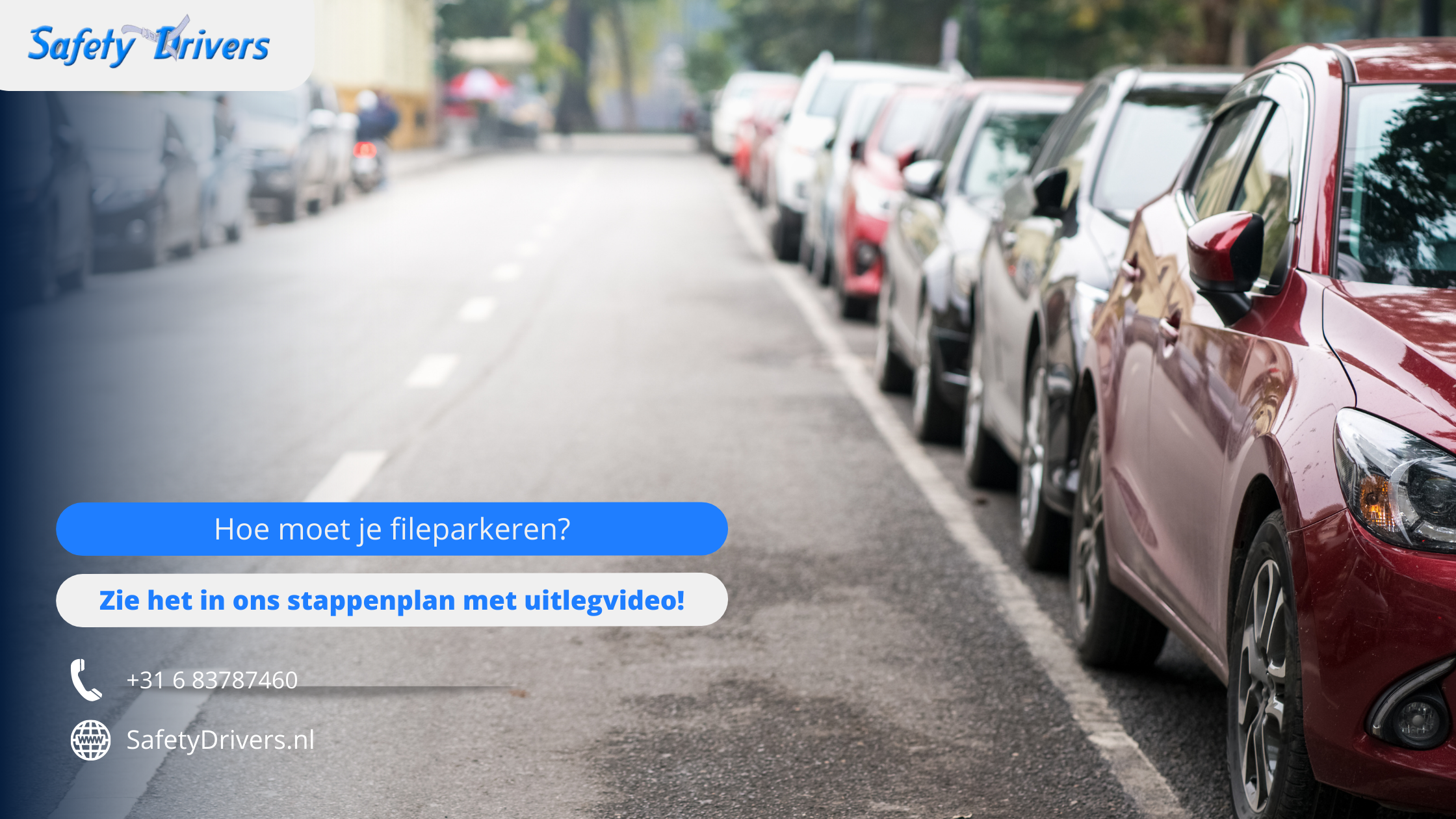
Everything about parallel parking
Oh dear, you are driving into a street where you can only parallel park, help! How do you do this? Below you will find a detailed step-by-step plan, with extra tips and an explainer video by SafetyDrivers! Here we cover parallel parking on the right side of the road.
Step-by-step plan for parallel parking
Step 1
As soon as you have received a parking instruction, start looking for a parking spot. Look ahead, in the rearview mirror, look ahead, in the right side mirror, and over your right shoulder before signaling and braking.
Step 2
As we mentioned in our tip on social media, you need approximately 1.5 times the length of the car in space to park neatly. So don't make it too difficult for yourself.
Step 3
Stop with your right mirror level with the left headlight of the parked car behind which you want to parallel park. Before you start driving, look around the car to determine where potential danger might come from and whether any danger is approaching. The correct viewing sequence is: forward, rearview mirror, left side mirror, left shoulder, forward, right side mirror, and over your right shoulder. The moment someone starts getting close, you must stop to give way. Every time after you have yielded to someone, look around the car again before continuing to drive. After all, you are performing a special maneuver.
Step 4
When it is safe, carefully reverse straight back. While doing so, keep checking your mirrors and over your left and right shoulders every 3 to 5 seconds. Before steering to the right, check one more time to be sure you are not being overtaken. The correct moment to check is when your rear seat is level with the rear seat of the red car. Look forward, in the rearview mirror, forward, in the left side mirror, and over your left shoulder to be certain you are not being overtaken.
Step 5
The moment your back seat is level with or just past the back of the parked car (and there is no danger approaching), steer quickly to the right while driving gently by repositioning your hands.
Step 6
Steering must be done smoothly and fully to the right. However, keep an eye on your surroundings. By steering, you reduce the space to your left! So stop in time if someone is approaching at high speed or is too close. Watch out for children playing between the cars! Caution! This is a dangerous moment because the front of the car swings out to the left. The moment you are being overtaken, it can be dangerous, so look carefully around you and stop in time to yield.
Step 7
The moment your right side mirror is at the back of the other car, steer to the left.
Step 8a
When the right side mirror is approximately level with the rear of the car, check both side mirrors to determine the speed of the steer. – If the distance between the car and the curb in your right side mirror is large, steer gently to the left while driving slowly. This brings you closer to the curb.
Step 8b
When the right side mirror is approximately level with the rear of the car, check both side mirrors to determine the speed of the steer. – If the distance between the car and the curb in your right side mirror is small, steer quickly to the left while driving even more slowly.
Step 9
The moment you steer left, you increase the space to your left, because the car is now turning inwards. Therefore, if someone is approaching from the main road in front of or behind you, you may proceed cautiously. After all, you are clearing the way for other road users because the front of your car is turning inwards. However, do stop if it is dangerous, for example, if someone is in the parking area.
Step 10
Stop the moment the car is level, and leave the front wheels turned (to the left) so that you can drive away immediately after parking. So, for your exam, you don't need to steer back! If you remain parked for longer, then you do need to straighten the tires. You do this by shifting into 1st gear, driving forward slowly, and quickly turning 1.5 turns to the right until your tires and steering wheel are straight.
Step 11
Look carefully around you before driving off. The correct viewing sequence is: ahead, rearview mirror, left side mirror, and over your left shoulder before indicating a left turn, and look one more time while driving off. Do not indicate if someone is approaching at high speed or if you cannot drive off yet because you must yield the right of way.
Step 12
If it is safe, drive slowly. Ideally, your tires should still be facing left; otherwise, steer quickly to the left. Steer to the right the moment your right headlight is just past the left taillight of the parked car. Do not steer back too quickly, as the rear of your car still needs to go around the parked car. Therefore, drive at a low speed and check your right mirror to see if you have enough space while pulling out. If possible, accelerate smoothly to the maximum speed. This depends on other traffic and the conditions at that moment.
Extra tips for parallel parking:
- Before you get in the car, check how much space you have in front of and behind the car to get away.
driving. Usually, you have to reverse a little bit to increase the space in front when
drive away. - Do not steer when dry, as this causes your tires to wear out faster.
- Do not go over a curb. This is bad for your tires, shock absorbers, etc.
- Always fold in your mirrors after parking. Otherwise, there is a chance that someone will drive over and break them.
- If you are parked close to a busy intersection or street and there is a long line/traffic jam, then
You are allowed to signal earlier to ask for space to drive away.